Blog
Convert PDF Bank Statement to CSV | A Clear Guide for Clean Transaction Data
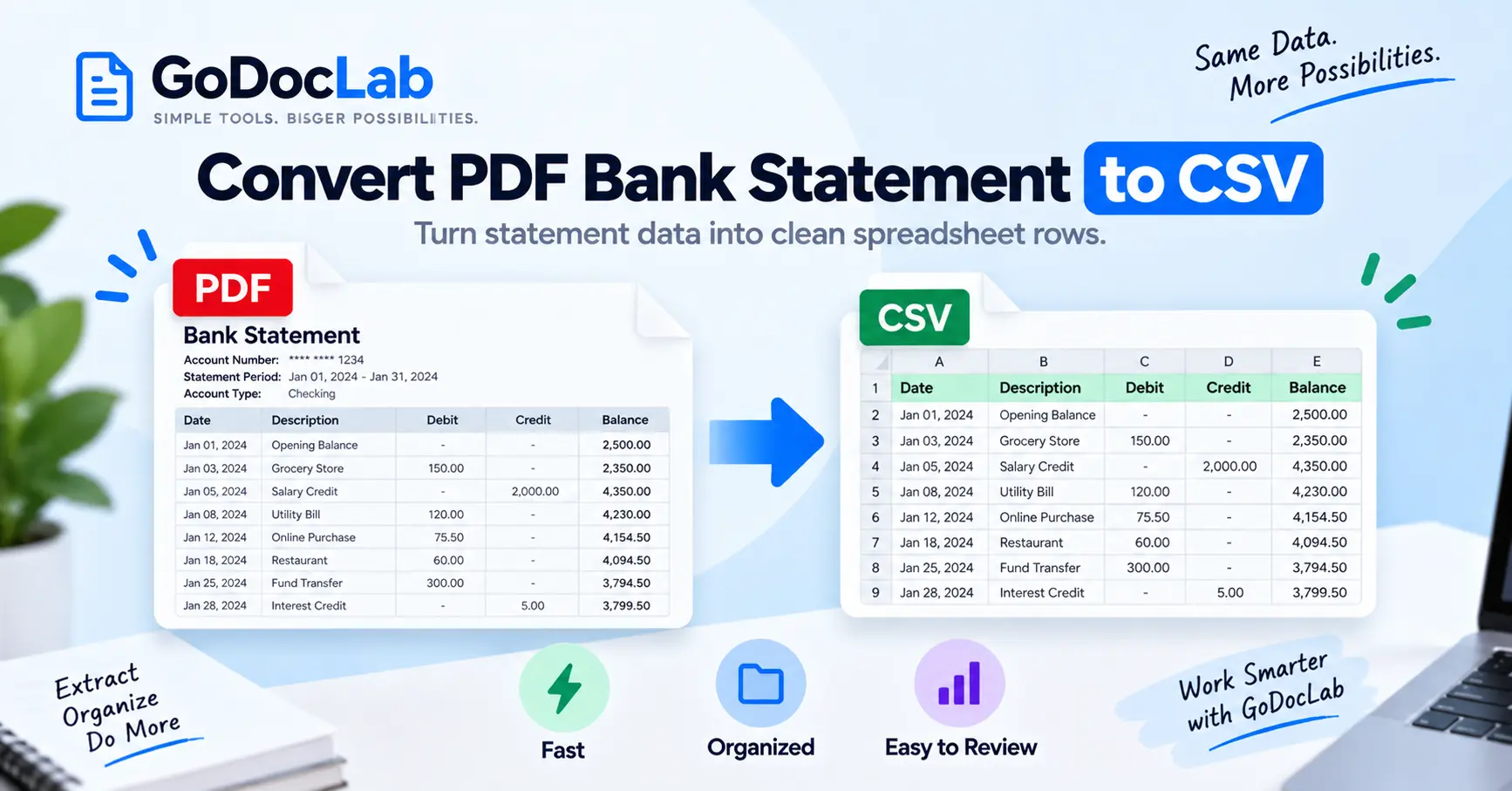
Bank statements often arrive as PDF files because PDFs keep the page layout steady and make documents easy to view or print. The problem starts when you need to sort transactions, check spending, prepare records, or move data into a spreadsheet. That is where Convert PDF bank statement to CSV helps, because CSV turns statement rows into structured data that spreadsheet software can read.
A CSV file stores data in rows and columns using separators, commonly commas. Microsoft says Excel can open CSV files directly or import them so users can control how columns are read. That makes CSV useful for dates, transaction descriptions, debit amounts, credit amounts, and balances.
Quick Answer: How to Convert a PDF Bank Statement to CSV
The process is simple when the PDF contains real text and clear tables. Open a PDF-to-CSV tool, add the statement, run the conversion, then review the result before using it for any financial task. GoDocLab’s extracts tabular PDF data and exports it as CSV.
Use this workflow:
Save the original bank statement in a safe folder.
Check whether you can select text inside the PDF.
Use PDF to CSV if the statement contains readable text.
Run OCR first if the statement is a scan.
Download the CSV file.
Open it in Excel or another spreadsheet app.
Check dates, descriptions, debits, credits, and balances.
Keep the source PDF until you finish checking the data.
A clean conversion can save a lot of manual typing, but the review step still matters. Bank statements contain numbers that can change meaning if one digit moves into the wrong column. The converter can do the repetitive work, while you make sure the final data still matches the statement.
Why Convert Bank Statement PDF Data to CSV?
A PDF bank statement works well as a record, but it is awkward for sorting and calculation. You may want to group payments by merchant, filter transactions by date, compare deposits with withdrawals, or prepare a spreadsheet for bookkeeping. Convert PDF bank statement to CSV gives you data that is easier to sort, filter, search, and review.
PDF to CSV, PDF to Excel, or OCR: Which One Do You Need?
Use Convert PDF bank statement to CSV when the final destination accepts CSV or when you want a simple table file. Use PDF to Excel when you prefer XLSX and want a workbook format from the start. Use OCR before either method if the bank statement is an image-based scan.
GoDocLab offers , , , and tools on the same site. These links give readers a useful path from the source statement to the file type they need. Each tool handles a different part of the job.
Check Whether Your Bank Statement Needs OCR
Open the statement and try to select a transaction description with your cursor. If you can highlight individual words, the PDF probably contains a usable text layer. If the whole page behaves like one picture, the file may be scanned and OCR may be needed before you Convert PDF bank statement to CSV.
Adobe explains that scanned PDFs can contain image data instead of searchable text. OCR turns image text into selectable and searchable text, and Adobe recommends checking the result for recognition errors. GoDocLab’s serves the same basic purpose for scanned documents.
After OCR, test a few transaction lines before converting the file. If dates or amounts already look wrong, use a clearer scan before moving on. A poor scan plus fast conversion still produces poor data.
How to Convert PDF Bank Statement to CSV With GoDocLab
GoDocLab’s PDF to CSV page says the tool extracts tabular data from a PDF and exports it as CSV. The current page accepts PDF files up to 100 MB and follows an upload, process, and download flow. That makes it a direct option for Convert PDF bank statement to CSV when the statement has a clear transaction table.
Start with the exact statement you need and check that every page is present. Process the PDF, download the CSV, and compare the first few rows with the original statement. Then check several rows from the middle and the final page, because layout changes can appear after page breaks.
Do not stop once the file opens successfully. Check whether columns line up and whether each amount belongs to the right transaction. A short review can save a much longer cleanup later.
What Columns Should You Check?
Bank statement layouts vary, so there is no single column set used by every bank. Common fields include transaction date, posting date, description, debit, credit, amount, and running balance. When you Convert PDF bank statement to CSV, follow the labels in the source statement rather than forcing a standard layout onto it.
Pay close attention to positive and negative values. Some statements separate money in and money out into credit and debit columns, while others use one amount column with signs. Your CSV should reflect what the source actually shows.
Long descriptions can also create trouble when text wraps onto another line in the PDF. A converter may split that text into another row if the table is hard to read. Merchant names and payment references deserve a quick check before you sort the CSV.
Review the CSV in Excel
Microsoft says Excel can open CSV files directly and can also import them through its text and CSV tools. Importing gives you more control over separators and column formats, which can help with dates or values that Excel might read incorrectly. This is useful after Convert PDF bank statement to CSV, especially when a statement uses local date or number formats.
Compare totals with the original PDF and check that decimal places stayed correct. Account numbers or references with leading zeros also deserve attention because spreadsheet software may treat them as ordinary numbers. Keep the bank-issued PDF beside you while checking the extracted rows.
If Excel displays a column incorrectly, use its import controls instead of fixing every cell one by one. Microsoft says users can choose the delimiter and review the data before loading it. That can make longer statements easier to clean.
Scanned Bank Statements Need Extra Care
A scanned statement adds a recognition step before conversion. Adobe says OCR creates searchable text from scanned PDF images, but it also advises users to review the result for errors. This matters for Convert PDF bank statement to CSV because one wrong digit can affect a date, amount, or balance.
Clean scans usually produce better results than blurry or tilted pages. Check page direction, cropped edges, weak contrast, and faint printing before starting OCR. If you have a clearer original statement, use it instead of trying to rescue a poor scan.
Watch characters that look alike, such as zero and the letter O, or one and lowercase l. Transaction IDs and reference numbers are easy places for these errors to hide. Numbers need extra attention because one character can change the value.
What If You Want an Excel File Instead?
CSV works well when you need a simple table file that many apps can read. If you prefer an XLSX workbook, GoDocLab’s converts PDF tables and data into an Excel spreadsheet. The tool page currently accepts PDF files up to 100 MB.
Choose Convert PDF bank statement to CSV when CSV is the format your next task requires. Choose PDF to Excel when you plan to keep the data in an XLSX workbook. In either case, compare the converted transaction rows with the original PDF before relying on the numbers.
Avoid adding extra format changes without a reason. Each extra conversion gives dates, separators, and number formats another chance to shift. The shortest valid route is usually easier to check.
Privacy Matters With Financial Documents
Bank statements contain private financial information, so treat them more carefully than an ordinary document. Before using any online converter, check the service’s privacy terms and the rules set by your bank, employer, accountant, or company. If your policy requires local processing, use an approved local method instead.
GoDocLab currently describes its tools as using private browser processing and says normal tool use does not require sign-up. Even with that statement, decide whether your statement is suitable for online processing under the rules that apply to you. Convert PDF bank statement to CSV should never mean skipping your own data-handling rules.
Protect the downloaded CSV as well because it can contain the same private transaction details as the PDF. Store working copies in a suitable location and remove temporary files you no longer need. A spreadsheet may look less formal than a bank statement, but the information inside can still be sensitive.
Common Mistakes to Avoid
The biggest mistake is treating successful conversion as proof that every row is correct. A CSV can open normally and still contain a shifted amount, missing minus sign, duplicate header, or broken date. Always compare the output with the bank-issued statement before using it for records or reports.
Avoid these errors:
Deleting the source PDF before checking the CSV
Skipping OCR on a scanned statement
Trusting every amount without sampling rows
Ignoring debit and credit column changes
Forgetting opening or closing balance rows
Uploading financial files without checking privacy rules
Importing the CSV elsewhere before reviewing it
Assuming every bank uses the same statement layout
A good Convert PDF bank statement to CSV process should feel boring. The rows line up, the totals agree, the dates make sense, and nothing surprising happens. Financial data has enough excitement already.
Final Check Before You Use the CSV
A good Convert PDF bank statement to CSV workflow starts with the right source file, uses OCR only when needed, and ends with a careful data check. GoDocLab PDF to CSV gives text-based statements a direct route, while OCR PDF helps with scans and PDF to Excel gives you an XLSX option. Use the tool that matches the source and the file format you actually need.
Before you use the CSV for bookkeeping, analysis, or another import, compare transaction dates, descriptions, amounts, balances, and totals with the original statement. Keep the source PDF until you finish checking the data, and follow the privacy rules that apply to your financial documents. A converter can save typing, but your review is what makes the result dependable.
For the direct workflow, start with and use only when the statement is scanned. That keeps Convert PDF bank statement to CSV focused on the shortest useful path. It also gives readers a clear next step instead of sending them through unrelated tools.
FAQs
Frequently asked questions
Yes. A PDF-to-CSV tool can extract readable transaction tables into a CSV file, while scanned statements may need OCR first. Check the converted rows against the original statement before using the data, and keep the PDF as your reference until the review is complete.