Blog
Save Webpage as PDF in Chrome | A Simple Guide That Works
A webpage can disappear, change, or become harder to find later, so saving a copy can be useful for receipts, research, booking details, articles, invoices, and reference pages. Chrome includes a print feature that can create a PDF from a webpage without installing another desktop app. If you need to Save webpage as PDF in Chrome, the basic process takes only a few clicks.
The PDF acts like a fixed copy of the page at the time you save it, but it may not behave exactly like the live website. Interactive menus, videos, login-only areas, and some dynamic content may not appear the same way in the saved file. That is why it helps to let the page finish loading and check the PDF before closing the original tab.
Quick Answer: How to Save Webpage as PDF in Chrome
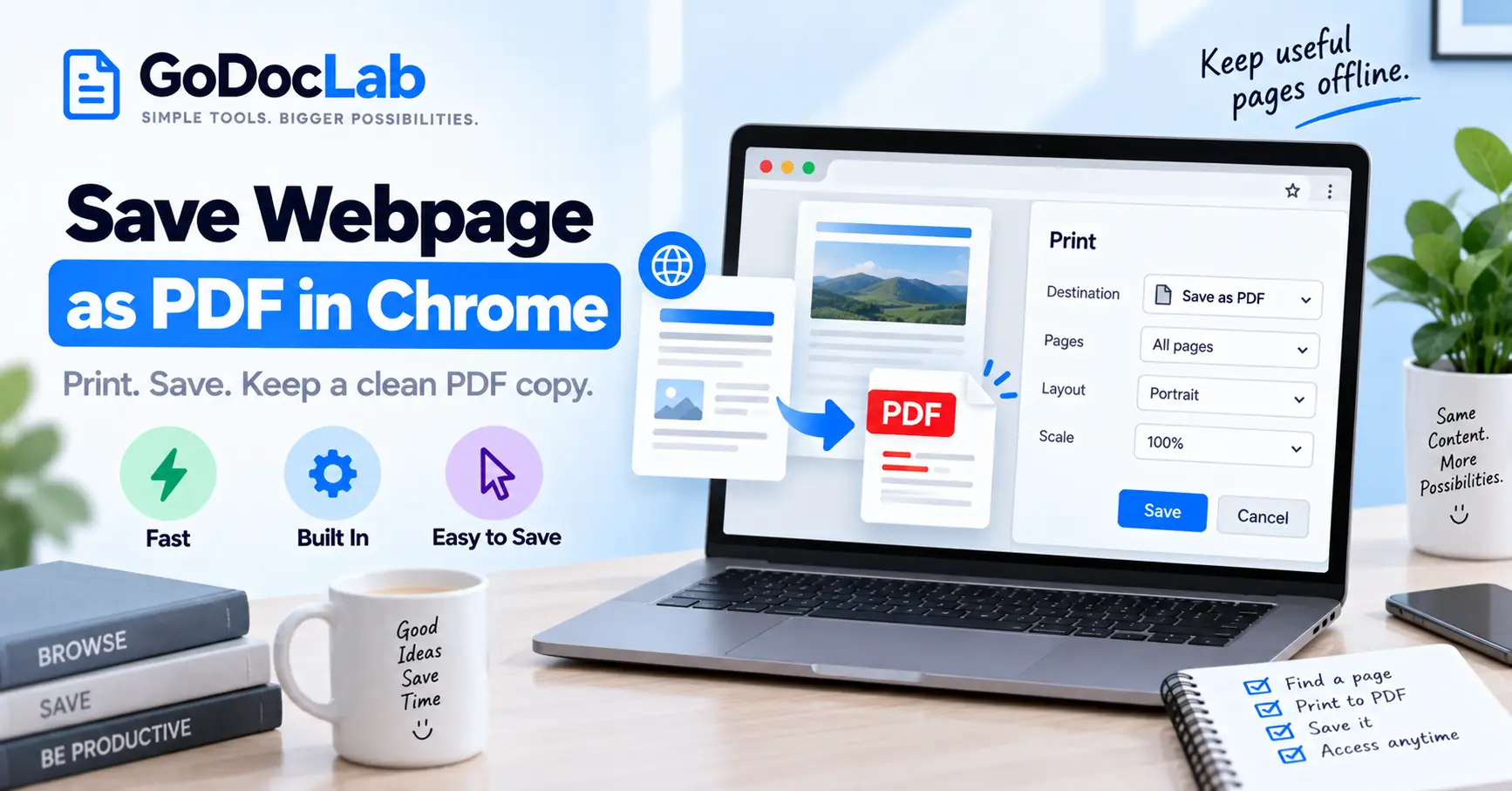
On a computer, Google says you can open Chrome, load the page, and choose File > Print, or use Ctrl + P on Windows and Linux and Command + P on Mac. Chrome then opens its print window, where you can choose a destination and change print settings. Google’s own help also refers to Save as PDF as a Chrome print destination.
Use this basic process to Save webpage as PDF in Chrome:
Open the webpage and let it load fully.
Press Ctrl + P on Windows or Linux, or Command + P on Mac.
Choose Save as PDF as the destination.
Check the page preview.
Adjust pages, orientation, margins, scale, and background graphics if needed.
Select Save.
Choose a file name and folder.
Open the PDF and check that the content appears correctly.
The final check matters because a website can use print styles that differ from its normal screen view. Ads, menus, sidebars, images, or wide tables may move or disappear in the print version. A clean preview is a better sign than simply seeing the Save button.
Best Ways to Save a Webpage as a PDF
For most desktop users, Chrome’s own print feature is the fastest place to start. A separate tool becomes useful when you have HTML files, need several PDFs combined, or want to clean the document after saving it. GoDocLab lists HTML to PDF, Compress PDF, Merge PDF, and Organize PDF in its PDF tool collection.
Save Webpage as PDF in Chrome on Windows
Windows users can open the page in Chrome and press Ctrl + P, which Google lists as the standard Chrome print shortcut for Windows and Linux. In the print window, choose Save as PDF rather than a physical printer, review the preview, and save the file where you want it.
Before you Save webpage as PDF in Chrome, scroll through pages that load content as you move down. Some sites fetch images, comments, or product details only after the visitor reaches that part of the page. Giving the page a moment to load can help the print preview include more of the visible content.
Save a Webpage as PDF in Chrome on Mac
The Mac process is very similar, but the shortcut changes. Google’s Chrome help lists Command + P for printing from Chrome on Mac, after which you can choose the destination and print settings.
If you Save webpage as PDF in Chrome on a Mac, check long tables and image-heavy pages before saving. A webpage may look wide on screen but become narrower in the print layout, which can move text onto extra pages. Changing the scale or orientation in the print controls can often improve the result.
Save a Webpage as PDF on Android
Chrome also supports PDF saving on Android through the print flow. Google says to open the page, tap More, choose Share, select Print, then choose Save as PDF from the printer menu and select where to store the file.
This makes Save webpage as PDF in Chrome useful when you need an offline copy from a phone rather than a desktop computer. Check the preview before saving because mobile pages can use a different layout from desktop pages. A responsive website may rearrange menus, images, and tables based on the screen size.
What About Chrome on iPhone and iPad?
Google’s current Chrome instructions for iPhone and iPad route printing through the Share menu and AirPrint. The official Chrome page explains how to open Share, select Print, choose settings, and send the page to AirPrint, but it does not describe the same built-in Save as PDF option shown in the Android guide.
That difference matters if your article targets people using several devices. Desktop Chrome and Android have clearly documented PDF-saving routes through print controls, while iPhone and iPad use Apple’s print system from Chrome. Keep the device named in the instructions so readers do not search for a button that may not appear in the same place.
Use Print Preview Before Saving
Print preview is where you catch most webpage-to-PDF problems. It shows how Chrome plans to divide the web content into pages, so you can spot blank pages, clipped sections, poor spacing, or images that do not fit. Google’s desktop help says Chrome lets users change their preferred print settings before completing the job.
When you Save webpage as PDF in Chrome, look at the first page, the last page, and any section with wide content. If a table gets cut off, try a different orientation or scale. If the PDF includes several empty pages, check whether the website has hidden print elements or large spacing between sections.
Background Graphics Can Change the Result
Webpages often use background colors, blocks, icons, and design elements that Chrome may treat differently during printing. The print dialog can include extra settings that affect margins, scale, headers, footers, and background graphics, depending on the page and Chrome version. Use the preview to decide whether those visual details help or simply make the PDF busier.
A receipt or invoice may look cleaner without unnecessary site navigation, while a design reference page may need its backgrounds to make sense. There is no single setting that fits every page. The right PDF is the one that keeps the content you actually need readable.
Headers and Footers May Add Extra Information
Chrome’s print output can include details such as the page title, URL, date, or page numbers when headers and footers are enabled. Those details can be helpful for research records because they show where the saved content came from. They can also clutter a clean client-facing PDF, so check the preview before saving.
For Save webpage as PDF in Chrome tasks involving research, keeping the URL in the PDF can make the source easier to trace later. For a presentation copy or attachment, you may prefer a cleaner page without browser-added text. The choice depends on why you are saving the webpage.
When Chrome Does Not Capture the Page Correctly
Some websites use scripts, expandable sections, lazy-loaded images, embedded maps, videos, or interactive dashboards that do not translate neatly into a printed page. A print-to-PDF copy records a printable view, not every function of the live website. A menu that opens on click or a chart that changes with filters may become static or may not appear at all.
If Save webpage as PDF in Chrome gives you a poor result, try opening all sections you need before printing and wait for images to load. For HTML content that you own or have saved as a file, GoDocLab lists an HTML to PDF tool that converts HTML files or web pages into PDF format.
Chrome Print to PDF vs HTML to PDF
Chrome Print to PDF works well when you are already viewing the page and need a quick copy. An HTML to PDF converter fits better when you have an HTML file, code, or a web document that needs a dedicated conversion flow. GoDocLab describes HTML to PDF as a tool for turning HTML files or web pages into fixed PDF documents.
If your only goal is to Save webpage as PDF in Chrome, start with Chrome because it avoids an extra upload step. If the browser output looks poor or you are working from HTML rather than a normal loaded page, the conversion tool gives you another route. Keeping both methods in the article covers the common search intent without forcing readers into one option.
What If the Saved Webpage PDF Is Too Large?
Long pages with many images can create bigger PDF files than expected. If the document becomes hard to attach to an email or upload to a portal, compression can reduce the file size after you save it. GoDocLab lists Compress PDF as a tool for reducing PDF size while keeping the document usable.
After you Save webpage as PDF in Chrome, use compression only if size creates a real problem. Open the smaller copy and check screenshots, charts, small labels, and body text before sending it. A tiny file is not much help if the words now look like they were printed through a foggy window.
Merge Several Saved Webpages Into One PDF
Research often involves more than one webpage. You may save a policy page, a product page, a receipt, and a reference article, then decide that one PDF would be easier to store or send. GoDocLab’s tool list includes Merge PDF for combining multiple PDF documents into a single file.
This gives Save webpage as PDF in Chrome a useful next step when several pages belong to the same project. Save each webpage separately, check each PDF, and then merge them in the order that makes sense. If the order changes later, Organize PDF or Reorder Pages can fix it without creating every file again.
Common Problems and Simple Fixes
Blank space, missing images, chopped tables, and unwanted navigation are the problems users see most often when turning web content into printable files. Many of these issues come from the website’s own print styling rather than Chrome itself. Let the page load, use print preview, adjust the settings, and save a test copy before you close anything important.
For Save webpage as PDF in Chrome, a second attempt with different scale or orientation settings may solve a page-break problem. If several blank or unwanted pages remain, GoDocLab lists Organize PDF and Delete Pages for page cleanup after saving.
Is a Saved Webpage PDF the Same as the Live Page?
No. A PDF is a fixed document copy, while the webpage can change after you save it, and interactive parts may not remain interactive in the same way. Dates, prices, stock status, comments, news updates, or account information can change on the live site later.
That is useful to know when you Save webpage as PDF in Chrome for records. The saved file shows what the printable page contained at that point, subject to what Chrome could render in the print output. Keep the source URL or other reference information if you may need to compare the PDF with the live page later.
Final Check Before You Save
A reliable Save webpage as PDF in Chrome process starts by letting the page load, opening print preview, choosing Save as PDF, and checking the layout before creating the file. Google’s current Chrome help supports the desktop print shortcuts and Android PDF-saving flow, so users can complete the core task with browser controls.
After saving, open the PDF and make sure the text, images, page breaks, and source details you need are present. If the result needs more work, GoDocLab can support the next steps with HTML to PDF, Compress PDF, Merge PDF, Organize PDF, and other PDF tools.
The goal is simple: save the useful part of the webpage in a file that remains easy to read later. A good PDF should preserve the content you came for and leave behind as much browser clutter as possible. That is much better than finding the page six months later and discovering the information has moved, changed, or vanished.
FAQs
Frequently asked questions
On Windows and Linux, Google lists Ctrl + P as the Chrome print shortcut, while Mac uses Command + P. After opening the print window, select the PDF destination, review the settings, and save the document.