Blog
Delete Blank Pages From PDF Online Free | PDF Cleanup Guide
Delete Blank Pages From PDF: A Simple Way to Clean Up Your File
Blank pages have a strange talent for appearing where nobody invited them. They often show up after scanning a double-sided document, combining several files, exporting a report, or editing a PDF. One blank sheet may seem harmless, but several empty pages can make a document look unfinished and make printing more annoying than it needs to be.
The good news is simple: you can delete blank pages from PDF files without rebuilding the whole document.
GoDocLab provides a browser-based Delete Pages tool that lets you upload a PDF, choose the pages you no longer need, process the file, and download the updated copy. The current tool page states that it accepts PDF files up to 100 MB.
Here is how the process works, what to watch for with scanned files, and how to avoid deleting a page that only looks empty.
How to Remove Blank Pages From PDF Files
The easiest method is to look through the document, find the empty pages, and remove those specific page numbers.
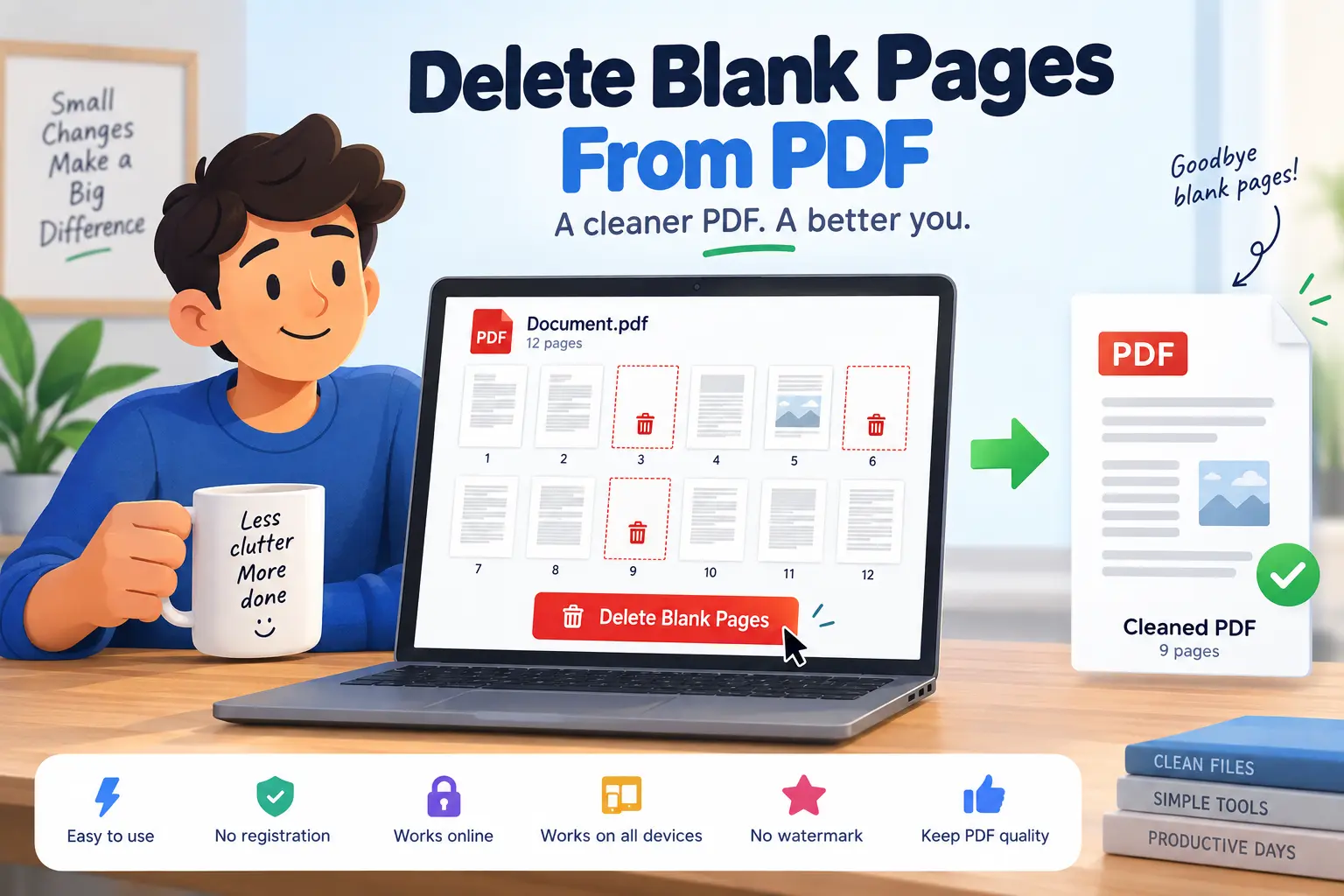
To remove blank pages from PDF, follow these steps:
- Open the GoDocLab Delete Pages tool.
- Upload or drag and drop your PDF.
- Review the document and note the blank or unwanted pages.
- Choose the pages you want to remove.
- Process the PDF.
- Download the cleaned file.
- Open the new PDF and check it before replacing your original copy.
GoDocLab lists its basic process as upload, configure, process, and download. That last check matters. A page that looks blank at first glance may contain a small signature, page number, faint scan, annotation, form field, or light text.
Deleting first and checking later is a great way to discover that page 14 was not as empty as it looked.
Why Do Blank Pages Appear in PDFs?
Blank pages can enter a PDF for several reasons.
Double-Sided Scanning
Duplex scanners capture both sides of each sheet. If one side has no visible content, the scanner may still create a page for it.
This explains why scanned contracts, invoices, school records, and office files often contain empty sheets between useful pages.
Some scanner software can detect these pages during scanning. HP, for example, documents a blank-page detection feature that checks scanned pages for content and uses a sensitivity setting to decide how empty a page must be before deletion.
This also explains why automatic blank page detection is not always perfect. A faint mark, shadow, punch hole, or scanner noise may make an empty sheet appear to contain something.
File Conversion
Document conversion can create extra pages when page breaks, margins, tables, or layout settings do not transfer as expected.
The result may be a final blank page or an empty sheet between sections.
Combining Several Documents
Merging files can leave unwanted separator pages in the final PDF.
If that happens, you do not need to rebuild the merged document. You can simply remove unwanted pages from PDF after the files have been combined.
Scanning Paper Documents
Old documents can contain shadows, stains, folds, pencil marks, or scanner noise.
A human may see an empty sheet, while software sees image data. That difference matters if you use an automatic PDF blank page remover.
Remove Blank Pages From Scanned PDF Files Carefully
A normal digital PDF and a scanned PDF are different in one useful way.
A digital PDF may contain real text and graphic objects. A scanned PDF often contains page-sized images. Even a nearly empty scanned page can still contain thousands of image pixels.
That means a scanned PDF blank page remover may need to decide whether a page is empty enough to remove.
HP's scanner documentation shows why sensitivity settings exist. Lower or higher sensitivity can change which scanned sheets count as blank.
For this reason, visual review remains a smart step.
If your scan also needs searchable text, GoDocLab offers an OCR PDF tool. Its current page says the tool can make scanned PDFs searchable with optical character recognition.
OCR and blank-page removal solve different problems:
OCR PDF helps software read text inside scanned pages.
Delete PDF pages removes pages you do not want in the document.
You may need both for a large scanned file.
How to Find Blank Pages in a PDF
Before you start deleting pages, find the empty ones accurately.
A preview PDF pages view or a page thumbnail view can make this much easier because you can inspect many pages without opening each one at full size.
Adobe also uses page thumbnails in Acrobat for page deletion. Its official instructions say users can select individual page thumbnails or specify several page numbers and ranges for removal.
A simple checking method works well:
Look for pages with no text, images, signatures, page numbers, stamps, or form content. Zoom in on pages that appear almost empty. Pay extra attention to scanned pages with faint marks.
If you have a 70-page scan, checking thumbnails beats clicking Next 69 times. Your mouse deserves some kindness too.
Delete Multiple PDF Pages at Once
Sometimes one blank page is not the problem.
You may need to remove multiple PDF pages, such as empty scanner pages, outdated sections, accidental duplicates, or extra pages at the end of a file.
Adobe confirms that its desktop page organizer supports both individual pages and multiple page numbers or ranges.
For GoDocLab users, the Delete Pages tool focuses on removing unwanted pages, while the Organize PDF tool can reorder, remove, or rearrange pages in one document.
Use Delete Pages when you know what needs to go.
Use Organize PDF when the document also needs page-order changes.
Delete Extra Pages From PDF or Organize the Whole File?
These jobs sound similar, but they solve slightly different problems.
Use a PDF page remover if you simply want to delete empty, duplicate, outdated, or unnecessary pages.
Use a PDF organizer if you also need to move pages into a new order.
For example, suppose your PDF contains this sequence:
Page 1
Page 2
Blank page
Page 5
Page 4
Page 6
Deleting the blank page fixes one problem. Pages 4 and 5 still sit in the wrong order.
In that case, the Organize PDF tool makes more sense because it handles page removal and rearrangement.
Remove Duplicate Pages From PDF Files
Duplicate pages need a little more care than blank ones.
A blank page usually gives you a clear yes-or-no choice. Duplicate pages may look almost identical while carrying small differences, such as a changed date, signature, note, or invoice number.
If you want to remove duplicate pages from PDF, compare both pages before deleting either one.
Check:
- Page numbers
- Dates
- Signatures
- Small notes
- Headers and footers
- Form fields
- Stamps
- Version numbers
Once you confirm the duplicate, use the page deletion tool to remove the unwanted copy.
Remove Trailing Blank Pages From PDF
Extra blank pages often appear at the end of converted documents.
They can come from page breaks, scanner feeds, empty document sections, or export settings.
To remove trailing blank pages from PDF, open the final few pages first. If they contain no useful content, select them for deletion and save a new copy.
This small cleanup can make reports, proposals, forms, and printable documents look much more finished.
It also prevents a printer from happily producing a sheet of premium-quality nothing.
Clean Up PDF Pages After Removing Blank Sheets
Page deletion may be one step in a larger cleanup.
After you delete blank PDF pages, check whether the remaining file needs other changes.
If pages sit in the wrong order, use Organize PDF.
If the PDF needs separate sections, use the Split PDF tool, which GoDocLab describes as a way to split a PDF into separate pages or page ranges.
If the file has become too large, the Compress PDF tool can reduce file size. Its current page says it supports PDF uploads up to 100 MB.
If you scanned the document and need searchable text, use OCR PDF.
These related tools create a useful PDF cleanup path without forcing unrelated links into the page.
Can You Remove Blank Pages From PDF Online for Free?
Yes. GoDocLab currently lists its PDF tools as free and says no sign-up is required for normal tool use. Its Delete Pages page provides upload, configuration, processing, and download steps directly in the browser.
So if you want to remove blank pages from PDF free, you can use the online page deletion tool without installing a desktop program.
Keep one point in mind: the current GoDocLab page describes page deletion, but it does not state that the tool automatically finds every blank page for you.
That distinction matters.
A PDF blank page remover may mean one of two things:
- A tool that lets you identify and remove blank pages yourself.
- A tool that scans the file and decides which pages count as blank.
Do not treat those features as identical.
Can You Delete Blank Pages From PDF on Windows, Mac, iPhone, and Android?
Browser-based PDF tools make device choice less of a problem.
GoDocLab states that its tools work through a browser on Windows, Mac, Linux, iOS, and Android.
That means the basic process stays similar across devices:
Upload the PDF, select the pages, process the document, and download the result.
Adobe also provides page deletion on Android and iOS through Acrobat, although Adobe's current mobile instructions state that page deletion requires an Acrobat subscription.
For people who only need a quick browser option, an online tool can save an app installation.
Does Removing Pages Reduce PDF Quality?
Deleting complete pages is different from compressing or rebuilding page content.
A page deletion job removes selected pages from the document. It does not need to make the text or images on every remaining page look worse.
Still, different software can process files in different ways, so check your finished PDF before sending or publishing it.
Adobe says its page deletion feature can remove unnecessary content while keeping the document structure and interactive items such as bookmarks and links.
Scanned-image cleanup needs more care. OCRmyPDF's documentation warns that some image-processing actions can rasterize pages or remove wanted content, which is another good reason to review scanned documents after automated cleanup.
Automatic Blank Page Removal vs Manual Page Deletion
Automatic removal sounds perfect: upload a file, let software find every empty sheet, and finish.
Real scans make that harder.
A coffee stain can look like content. A faint pencil note can look like noise. A tiny page number can make a mostly empty sheet worth keeping.
Automatic systems often rely on a threshold or sensitivity setting. HP's documented scanner feature is one real example.
Manual review takes a little more time, but it gives you direct control.
For legal records, signed documents, financial files, school records, and contracts, that extra check can prevent a bad deletion.
Tips Before You Delete PDF Pages
A few simple habits can save trouble:
- Keep the original PDF until you check the new version.
- Review blank-looking scanned pages at a higher zoom level.
- Check headers, footers, signatures, and page numbers.
- Confirm page ranges before deleting several pages.
- Open the downloaded PDF and check the page count.
- Use OCR separately if your scanned file needs searchable text.
- Use a page organizer if the remaining pages need a new order.
Adobe also tells users to check document security restrictions if Acrobat will not allow page deletion. Some PDFs limit editing through document permissions.
FAQs
Frequently asked questions
Upload your PDF to a page removal tool, find the blank pages, select them, and delete them. After that, download the cleaned PDF and check that all useful pages are still there.