Blog
Convert Scanned PDF to Editable Word | A Simple OCR Guide
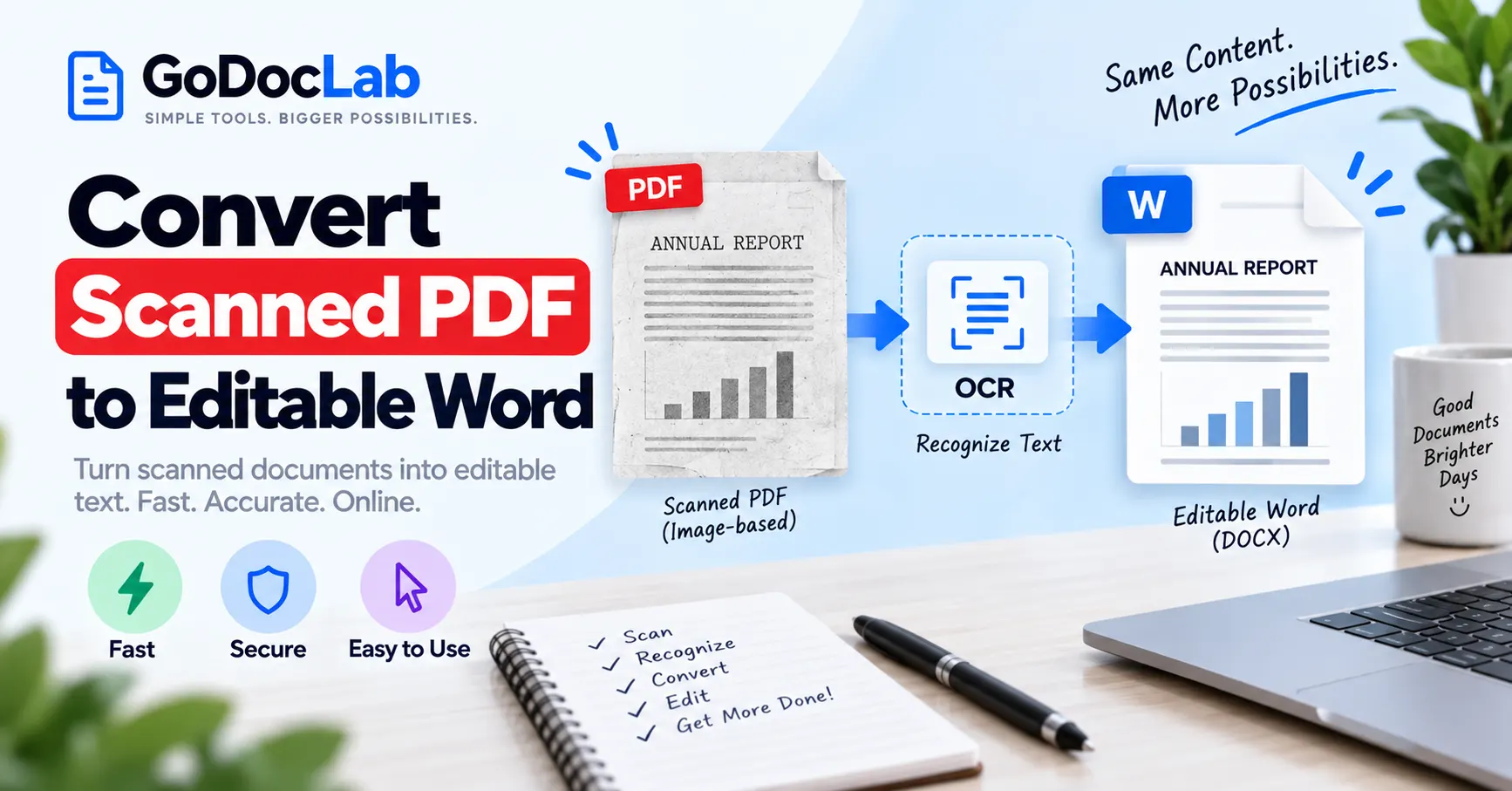
A scanned PDF often looks like a normal document, but there is one catch. The words on the page may actually be part of an image, which means you cannot click into a sentence and edit it like a Word file.
To Convert scanned PDF to editable Word, the file usually needs OCR before or during conversion. OCR reads text from scanned page images and turns it into text that software can search, select, and process. Adobe confirms that scanned PDFs can contain image data rather than searchable text until OCR creates a text layer.
This guide explains the process, what affects OCR quality, how to protect formatting, and what to check before you use the converted Word file.
Quick Answer: How to Convert Scanned PDF to Editable Word
The basic process is simple. Run OCR on the scanned PDF, then convert the recognized PDF into a Word document.
Follow these steps:
Open an OCR PDF tool.
Upload your scanned PDF.
Run text recognition.
Download the searchable PDF.
Open a PDF to Word converter.
Upload the OCR-processed PDF.
Convert it to DOCX.
Open the Word file and check the text and layout.
GoDocLab provides an OCR PDF tool that makes scanned PDFs searchable, plus a PDF to Word converter that creates editable DOCX files.
What Is a Scanned PDF?
A scanned PDF usually comes from a paper document that someone scanned with a printer, office scanner, or phone. Each page may work more like a photograph than a digital text document.
That difference matters when you Convert scanned PDF to editable Word. A normal digital PDF may already contain real text objects. A scanned PDF may need software to recognize the letters before Word can work with them.
Adobe explains that scanning paper to PDF can create a document that contains image data instead of searchable text. OCR adds recognized text to that document.
A simple test helps: try selecting one sentence in the PDF. If you cannot select the words individually, you may be dealing with an image-based scan.
What Does OCR Do?
Optical Character Recognition, usually called OCR, analyzes an image and tries to identify the letters, numbers, and words it contains.
For example, your scan may show the sentence:
Annual Sales Report 2026
To your computer, that page may begin as pixels. OCR tries to recognize those shapes as real letters and creates text that software can search or copy.
That is why OCR sits at the center of any good Convert scanned PDF to editable Word process. Without text recognition, a converter may treat a full scanned page as one large image.
Adobe says its OCR feature creates a searchable text layer in scanned PDFs and recommends checking the processed file for recognition errors.
Scanned PDF, OCR PDF, and Word File: What Changes?
The goal is not simply to change the file extension. You want the final Word file to contain text you can actually edit.
A .docx file filled with page images is technically a Word document, but it does not solve the real problem.
Step 1: Run OCR on the Scanned PDF
Start with text recognition. GoDocLab’s OCR PDF tool accepts scanned PDFs and describes its main job as making them searchable with Optical Character Recognition.
To Convert scanned PDF to editable Word, upload the scan, choose the available OCR settings, process the document, and download the result.
Keep the original scan as a backup. Adobe also recommends saving an original copy before working with OCR, especially when the document matters.
Once OCR finishes, try selecting a sentence in the processed PDF. If you can highlight individual words, the file is in a better state for conversion.
Step 2: Convert the OCR PDF to Word
Next, send the searchable PDF to a PDF to Word converter.
GoDocLab’s PDF to Word page says the tool converts PDF documents into editable Word DOCX format. Its listed process is upload, process, and download.
This second step handles the document conversion. OCR handles text recognition, while PDF-to-Word conversion rebuilds that recognized material in a Word-friendly format.
That distinction helps explain why Convert scanned PDF to editable Word can require two stages instead of one magic button.
Does Microsoft Word Open Scanned PDFs?
Microsoft Word can open PDF files and convert them into editable Word documents. Microsoft says the process works best with documents that contain mostly text.
There is a catch with scans. Microsoft notes that some PDF pages may appear as images if Word cannot treat their content as editable text. In that case, you cannot edit the words normally.
For this reason, running OCR first can make sense when you Convert scanned PDF to editable Word, especially if the document came directly from a scanner.
Microsoft also warns that the converted Word file may not match the PDF page for page. Line breaks, page breaks, and other elements can shift.
What Affects OCR Accuracy?
OCR can save a huge amount of typing, but it is not perfect. The quality of the source scan makes a big difference.
Check these factors before conversion:
Scan clarity: blurry letters are harder to recognize.
Page angle: tilted scans can cause reading errors.
Contrast: faint gray text may be harder to detect.
Font style: unusual typefaces can cause mistakes.
Page layout: columns and complex forms need more checking.
Handwriting: handwritten text can be harder to recognize than printed text.
Marks and stains: shadows, stamps, and scanner noise can interfere with recognition.
Language: OCR settings should match the document language when the tool offers that option.
Adobe tells users to choose the correct document language during OCR and to review the output after processing.
How to Get Better Results From a Scanned PDF
Start with the clearest copy you have. If one scan looks sharp and another looks like it survived three photocopiers and a rainy bus ride, choose the sharp one.
Before you Convert scanned PDF to editable Word, rotate sideways pages and make sure no text gets cut off near the page edges.
If the file includes blank or unwanted pages, remove them before conversion. GoDocLab also provides page organization tools as part of its PDF tool collection.
For large scans, check a few pages first. If page 2 already turns Invoice No. 1088 into something strange, fixing the scan before processing 200 pages can save a lot of editing later.
What Happens to Formatting?
Word and PDF store documents differently. A PDF tries to keep a fixed visual layout, while Word builds editable paragraphs, tables, images, headings, and other document parts.
When you Convert scanned PDF to editable Word, the software has to guess how those visual elements should become editable Word content.
Microsoft says PDF conversion may not reproduce the original file exactly. Some page breaks and lines can move, and PDFs with many graphics may convert poorly.
Expect to review:
Headings
Paragraph spacing
Tables
Columns
Page breaks
Images
Headers and footers
Bullet lists
Font sizes
Alignment
A good conversion saves typing. It does not remove the need for a final check.
Tables Need Extra Attention
Tables can cause more trouble than normal paragraphs because the converter must work out where every row, column, and cell belongs.
If your scan contains financial tables, schedules, invoices, or forms, compare the Word version with the original PDF line by line.
A single OCR error in ordinary text may look silly. A wrong digit inside a price, account total, date, or measurement can change the meaning of the document.
That is why anyone who Convert scanned PDF to editable Word for business, legal, academic, or financial work should check numbers separately from normal text.
Keep Names, Dates, and Numbers Under a Microscope
OCR mistakes often hide inside short pieces of information. A capital O can look like zero. A lowercase l can look like the number one.
After conversion, check:
People’s names
Company names
Email addresses
Phone numbers
Dates
Prices
Invoice numbers
Reference codes
Technical terms
Addresses
Do not assume a sentence is correct just because it looks normal at a quick glance.
If you Convert scanned PDF to editable Word for a contract or official form, compare every key value against the original scan.
PDF to Word vs PDF to Text
These tools have different goals.
A PDF to Word converter tries to create an editable document and keep useful structure such as paragraphs, headings, and some layout.
A PDF to Text tool focuses on extracting plain text. GoDocLab lists both PDF to Word and PDF to Text among its PDF conversion tools.
Use Word when you want to edit and keep document structure. Use plain text when formatting does not matter and you mainly want the written content.
What If You Only Need the Text?
Sometimes a full DOCX conversion creates extra work because you only need a few paragraphs from an old scan.
In that case, OCR followed by text extraction may be enough. GoDocLab lists OCR PDF for searchable scanned files and PDF to Text for plain-text extraction.
If you need to edit the whole report, though, Convert scanned PDF to editable Word is the better path because DOCX gives you a normal document workspace.
Is It Safe to Convert Scanned PDFs Online?
Before uploading private documents, check the service’s privacy terms and your own workplace or client rules.
GoDocLab states that its tools use HTTPS connections and automatically remove processed files from its servers. Its site also says users can process files without creating an account.
For medical records, identity documents, private contracts, financial records, or confidential business files, follow the data rules that apply to your organization.
If local processing is required, use approved desktop software instead.
Common Mistakes to Avoid
Many conversion problems begin before the file reaches Word.
Avoid these mistakes:
Converting a blurry scan without checking it
Skipping OCR on an image-based PDF
Deleting the original PDF too early
Trusting every recognized number
Ignoring sideways pages
Assuming tables converted perfectly
Sending the Word file without proofreading it
Using a low-quality scan when a clearer copy exists
The software handles the repetitive part. Your review catches the odd things, like 2026 becoming 2O26 and quietly pretending nothing happened.
Final Check Before You Start Editing
A reliable Convert scanned PDF to editable Word process has three parts: recognize the text, convert the document, and check the result.
Start with GoDocLab OCR PDF to make the scanned file searchable. Then use GoDocLab PDF to Word to create an editable DOCX file.
Keep the original PDF nearby while proofreading. Check names, dates, numbers, tables, and page breaks before you treat the Word version as finished.
OCR can save you from typing an entire scanned document by hand. That alone is a pretty good reason to let the computer read the pages first.
FAQs
Frequently asked questions
Yes. Use OCR to recognize the text inside scanned pages, then convert the searchable PDF into DOCX. Adobe confirms that OCR can create searchable text from scanned PDF images, while Microsoft supports opening PDF documents in Word for conversion.