Blog
Convert PDF to EPUB | A Simple Guide for Better Ebook Reading
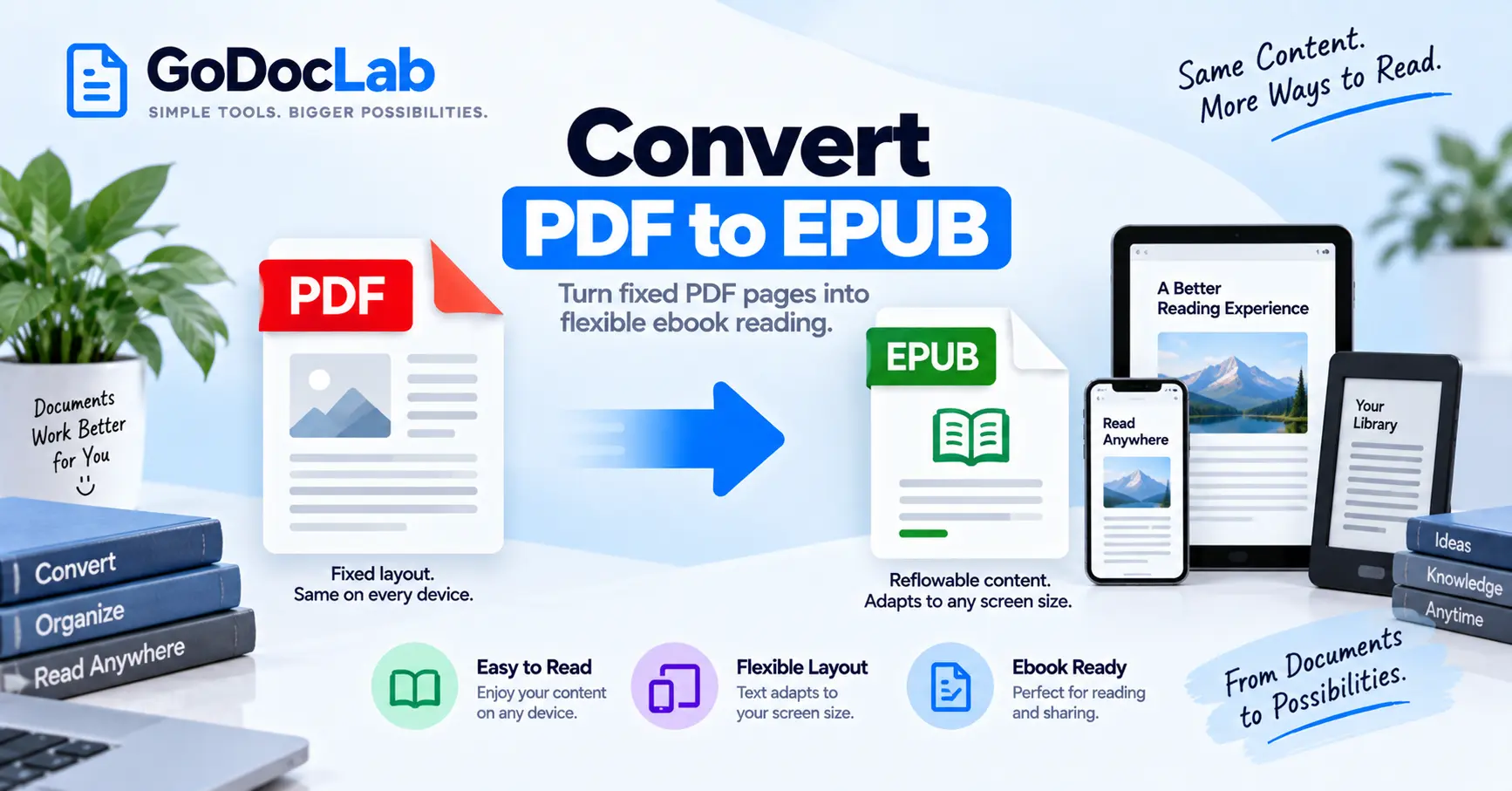
PDF files keep text, images, and page elements in fixed positions, which works well for reports, forms, and print-ready documents. EPUB usually handles text differently because the content can adjust to the screen size and reader settings. If you need to Convert PDF to EPUB, the goal is to turn fixed pages into an ebook that feels easier to read on phones, tablets, and e-readers.
The result depends on the source file. A clean text-based PDF usually converts more neatly than a scanned document made from page images. Tables, columns, footnotes, charts, and decorative layouts also need more checking after conversion.
Quick Answer: How to Convert PDF to EPUB
The basic process is simple: check the PDF, run OCR if it is scanned, convert the file, then review the EPUB in an ebook reader. GoDocLab’s currently accepts PDF files up to 100 MB and uses an upload, process, and download flow. This gives you a direct browser option when you want to Convert PDF to EPUB without adding another desktop app.
Use this process:
Open the GoDocLab PDF to EPUB tool.
Upload the PDF.
Run OCR first if the pages are scanned images.
Start the conversion.
Download the EPUB.
Open it in an ebook reader.
Check headings, images, tables, links, and chapter order.
Keep the original PDF until the review is complete.
A successful download does not mean every page changed perfectly. The ebook should still read in a clear order and remain comfortable on a smaller screen. A quick review can catch a broken table, misplaced image, or heading that wandered off like it had weekend plans.
PDF vs EPUB: What Changes?
PDF and EPUB solve different document problems. The says EPUB content normally reflows to fit available screen space, though EPUB can also use fixed layouts. That is why Convert PDF to EPUB can change line breaks, pagination, image placement, and spacing even when the written content stays the same.
A PDF may look identical every time because its page positions stay fixed. An EPUB reader can change text size, margins, and pagination, so one chapter may look different on a phone and an e-reader. Judge the converted file by reading quality rather than expecting a copy of the original page design.
Why Convert a PDF Into EPUB?
A PDF can feel cramped on a phone because readers may need to zoom and move around the page. A reflowable EPUB can fit long text to the display, which often makes books, study notes, and text-heavy reports easier to read. This is a common reason people Convert PDF to EPUB instead of keeping a fixed-page file.
EPUB can also provide a table of contents and a defined reading order. W3C says the EPUB navigation document supports key navigation features, while the EPUB spine defines the default sequence of content. A clean structure can make a long converted file much easier to browse.
Convert PDF to EPUB Online With GoDocLab
GoDocLab’s PDF to EPUB tool says it converts PDF documents into EPUB ebook format. Its current page lists PDF as the supported input, a 100 MB maximum file size, and a three-step upload, process, and download flow. The page also states that normal use does not require sign-up.
After you Convert PDF to EPUB, open the result in an ebook reader and inspect more than the cover. Check one section near the start, another in the middle, and one near the end. Repeated problems often show up after a chapter break or image-heavy page.
Check Whether the PDF Needs OCR
Try selecting a sentence in the PDF before conversion. If you can highlight individual words, the file probably contains usable text; if the entire page behaves like a picture, it may be a scanned PDF. In that case, OCR can help before you Convert PDF to EPUB.
Adobe explains that scanned PDFs can contain image data instead of searchable text and that OCR creates a searchable text layer. GoDocLab also provides an for scanned documents, with a current 100 MB file limit. Review names, dates, numbers, and unusual terms because recognition can make errors.
Use OCR Carefully for Scanned PDFs
OCR identifies letters and numbers inside page images, giving the converter text it can work with. For scanned PDF to EPUB jobs, that can make the difference between flexible text and an ebook that behaves like a stack of pictures. After OCR, compare important details with the original page before moving to conversion.
Adobe advises checking recognized text because unclear characters can be read incorrectly. A zero can become the letter O, or a one can look like a lowercase l, which matters in codes and figures. If the scan is blurry or tilted, a cleaner source can save a lot of correction work.
What Happens to PDF Page Numbers?
PDF page numbers belong to fixed pages, while reflowable EPUB content can paginate differently based on screen size and reader settings. W3C says reading systems may apply dynamic pagination to reflowable content. When you Convert PDF to EPUB, do not expect the ebook to keep the same page count.
Printed headers and footers can also enter the main text if the converter treats them as normal content. Check repeated page numbers, report names, dates, and footer text after conversion. Removing repeated clutter can make the ebook easier to read.
Tables, Columns, and Images Need Extra Review
Tables depend on rows and columns staying connected, while EPUB text often needs to fit narrow screens. Multi-column PDF pages create a similar issue because software must decide the correct reading order, and images may move above or below nearby text. If you Convert PDF to EPUB from a report, journal article, brochure, or price list, inspect these areas closely.
Compare important table values with the PDF and check that captions still sit near the right images. Large pictures can also increase the EPUB file size, while small diagrams can become hard to read on a phone. A converter can move content quickly, but it cannot ask whether column C moving into column B makes financial sense.
Check the EPUB Table of Contents
A long ebook needs clear navigation. W3C says the EPUB navigation document provides key features such as the table of contents, while the spine defines the default reading order. These features matter after you Convert PDF to EPUB from a long book, handbook, or report.
Check that chapter titles appear in the right order and that links open the correct sections. If the PDF used large text instead of real heading structure, the converter may have less useful structure to read. A well-organized source gives the final ebook a better chance of clean navigation.
What If the PDF Is Too Large?
Image-heavy or scanned PDFs can be large. GoDocLab’s currently accepts PDF files up to 100 MB and is meant to reduce file size. Use it only if size blocks your upload or conversion, because strong compression can make small text and diagrams harder to read.
If you compress before you Convert PDF to EPUB, keep the original PDF and inspect the smaller copy first. Text-based documents may need little or no compression, while scans can change more. The useful file is the one that stays readable, not simply the one with the smallest number beside MB.
Common Mistakes to Avoid
Most problems come from skipping checks before or after conversion. A text-based report, a scanned archive, and a magazine-style PDF can behave very differently. Use this checklist before you treat the EPUB as finished:
Run OCR on image-only PDFs.
Keep the original PDF.
Check tables and multi-column reading order.
Review images and captions.
Test the table of contents.
Check names and numbers after OCR.
Do not expect the same PDF page count.
Avoid heavy compression unless file size causes a problem.
Convert only files you are allowed to process.
A good conversion workflow should end with an ebook that reads naturally, not one that merely opens. Test headings, links, chapters, images, and several pages of normal body text in a real reader. If something looks wrong, compare it with the source PDF before sharing the ebook.
Final Check Before You Save or Share
A reliable Convert PDF to EPUB process starts by checking whether the PDF contains real text, using OCR for scans, and reviewing the converted ebook in a reader. Confirm headings, chapter order, images, tables, links, and the table of contents before sharing the file. Some layout change is expected because EPUB usually reflows while PDF keeps fixed pages.
For the direct GoDocLab route, use the , then use first if the document is scanned. can help if file size blocks processing, while gives you the reverse option when fixed pages are needed again. Keep the source PDF until the EPUB passes your final check.
FAQs
Frequently asked questions
Yes. GoDocLab provides a browser-based PDF to EPUB tool that currently accepts PDF files up to 100 MB. Review the downloaded EPUB in an ebook reader before treating the conversion as complete.