Blog
Convert Excel to PDF | A Simple Guide for Clean, Shareable Spreadsheets
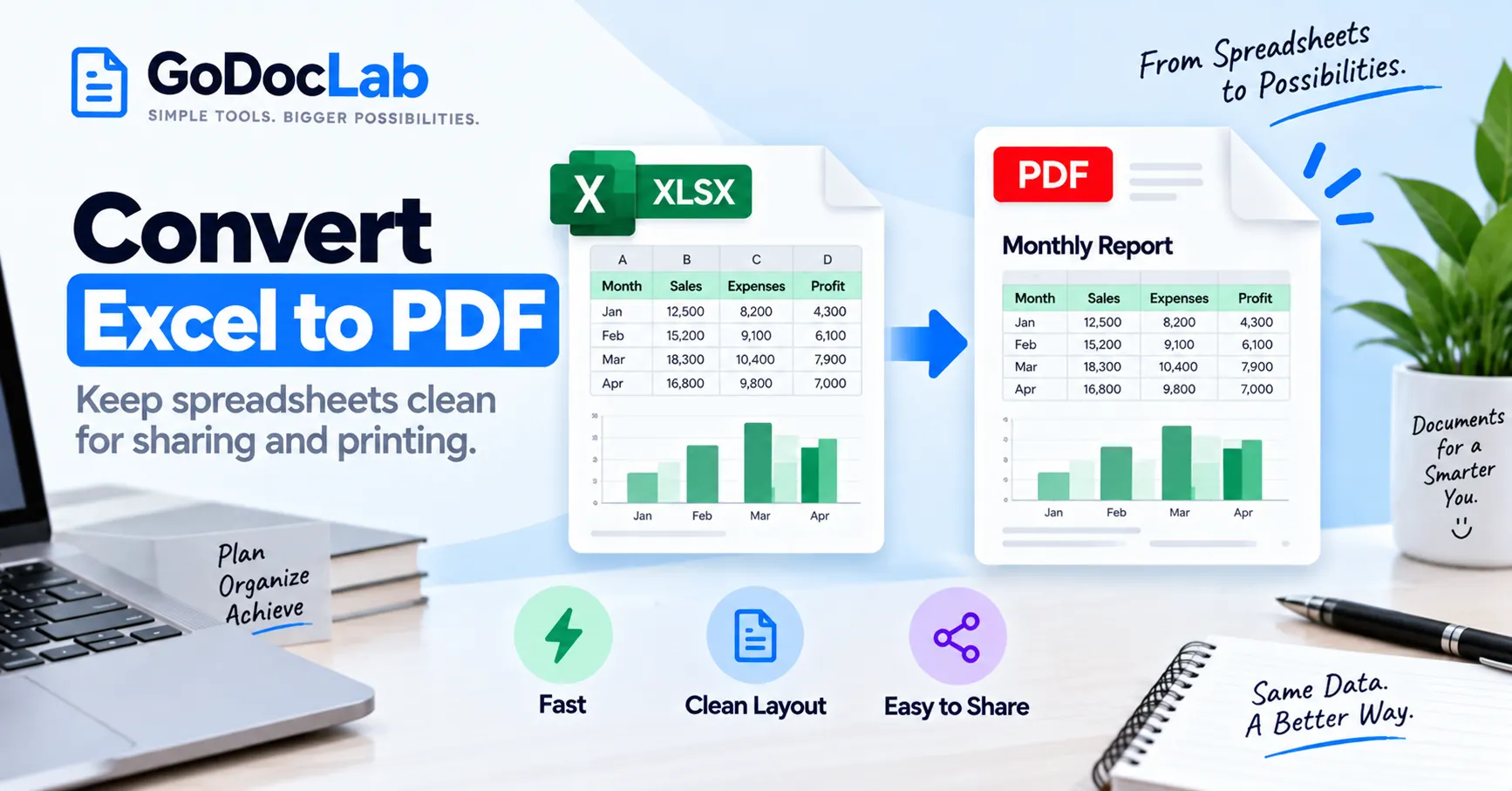
Excel files are great for formulas, tables, charts, and data entry, but they are not always the best format for sharing a finished report. A workbook can look different if the other person changes column widths, opens it in another app, or edits the wrong cell by accident. That is why many people Convert Excel to PDF before sending invoices, reports, schedules, budgets, or business records.
PDF gives the file a fixed page layout that is easier to view, print, and share. Microsoft says PDF is useful when you want a document to keep its formatting across devices and when the file is mainly meant to be read rather than edited.
Quick Answer: How to Convert Excel to PDF
You can Convert Excel to PDF directly inside Microsoft Excel or use an online converter. In Excel, open the workbook, choose Save As, select PDF as the file type, review the page settings, and save the file. Microsoft also lets you choose print quality and the pages or sheets you want to include.
For a browser method, GoDocLab offers an Excel to PDF tool that accepts XLS and XLSX files. Its current tool page shows an upload, process, and download flow, with a listed file limit of 100 MB.
Best Ways to Convert an Excel Spreadsheet to PDF
Different methods fit different jobs, so the best choice depends on whether you need speed, print control, or a browser option. A small invoice may need only a quick conversion, while a wide financial report may need scaling and print-area changes first. The table below gives a simple comparison.
If you Convert Excel to PDF for regular office work, Microsoft Excel gives you the most direct control over how the sheet fits on each page. If you just need a quick conversion from XLS or XLSX in a browser, GoDocLab gives you a shorter route.
Convert Excel to PDF With Microsoft Excel
Microsoft says Excel can save a workbook as a PDF from the Save As menu. You can choose PDF as the file type, select a quality option, and use the Options menu to control the output. This makes the built-in method useful when you need to decide which part of the workbook appears in the final file.
To Convert Excel to PDF in Excel, follow these steps:
Open the Excel workbook.
Check the sheets you want to include.
Choose File and then Save As or Save a Copy.
Select PDF as the file type.
Review the available PDF options.
Choose the folder and file name.
Save the PDF.
Open the new file and check every page.
Do not skip the final check because Excel sheets often contain wide tables that do not fit neatly on standard paper. A workbook can be perfect on screen but turn into a PDF with three nearly empty pages and one lonely column on page four. The data is technically there, but the reader may wonder what happened.
Convert Excel to PDF Online With GoDocLab
GoDocLab’s converts XLS and XLSX spreadsheets into PDF format. The live tool page currently lists support for files up to 100 MB and uses a simple upload, process, and download flow.
This method can help when you need to Convert Excel to PDF without opening the workbook in the desktop Excel app. Upload the spreadsheet, run the conversion, then open the resulting PDF and check that tables, charts, and sheet content appear where expected. Keep the original Excel file because the PDF is the sharing copy, not the best place for future formula edits.
Set the Print Area Before Conversion
A workbook may contain notes, helper columns, calculations, or old data that should not appear in the PDF. Microsoft lets you define a print area so only selected cells print or export as part of the page output. A worksheet can also contain more than one print area, and each separate area can print on its own page.
Before you Convert Excel to PDF, select only the section you want people to see if the workbook contains extra working data. Open Page Layout, set the print area, then use Print Preview to see whether the output looks clean. This step can prevent internal notes or unused columns from showing up in the final PDF.
Fit Wide Excel Tables on PDF Pages
Wide spreadsheets are one of the most common reasons an Excel-to-PDF file looks messy. Microsoft provides Scale to Fit settings that can reduce a worksheet so its columns fit across a chosen number of pages. You can set the width to one page while allowing the rows to continue onto more pages.
When you Convert Excel to PDF, fitting every row and every column onto one page is not always a good idea. Microsoft warns that heavy scaling can make the printed data difficult to read because the content becomes very small. A better choice for a long table is often one page wide with several pages tall.
Choose Portrait or Landscape Carefully
Page direction can make a big difference to spreadsheet readability. A narrow list may look fine in portrait mode, while a report with many columns usually has more room in landscape mode. Microsoft’s Page Setup options let you choose the orientation and adjust paper size, margins, and scaling.
Check Print Preview before you Convert Excel to PDF and look at the page edges. If a table breaks in an awkward place, switching the orientation may solve the problem without shrinking the text too much. Sometimes one click saves twelve minutes of fighting with column widths.
Check Page Breaks Before Saving
Excel adds page breaks based on paper size, margins, scaling, and worksheet content. Microsoft also lets users insert or move manual page breaks so reports can start or end at better points. Page Break Preview shows where each printed page begins and ends.
Use that view before you Convert Excel to PDF if the workbook contains several sections. Try to keep headings with the data below them and avoid leaving one row from a table alone on a new page. A clean page break makes the PDF easier to read and usually looks more professional.
Excel to PDF Settings That Matter
A few settings can change the final PDF much more than people expect. Check the workbook in Print Preview instead of trusting the spreadsheet view alone. Microsoft says Excel’s print tools let you control the active sheets, entire workbook, selection, margins, paper size, and related page settings.
Before saving, review these items:
Print area: Include only the cells that belong in the final file.
Orientation: Use portrait or landscape based on the table width.
Scaling: Keep columns together without making text too small.
Margins: Give the data enough room around page edges.
Page breaks: Make sure tables split in sensible places.
Sheets: Confirm that the right worksheets are included.
Charts: Check that no chart is cut at a page boundary.
Headers and footers: Review dates, titles, and page numbers.
These checks make Convert Excel to PDF more than a file-format change. They turn a working spreadsheet into a document that someone can read without opening Excel. That difference matters for reports, invoices, schedules, proposals, and records.
Will Formulas Still Work in the PDF?
A PDF shows the results that appear in the spreadsheet, but it does not work like the original Excel workbook. The formulas, editable cells, and workbook logic belong in the Excel file, so keep the XLSX copy if you may need to update calculations later. Microsoft also notes that saving a workbook in another format can affect some data, formatting, or features.
When you Convert Excel to PDF, think of the PDF as the finished reading copy. Use it for sharing, review, printing, or records, but keep the original workbook as the working source. That way, you can change formulas later and create a fresh PDF when the numbers change.
What Happens to Links in an Excel PDF?
Microsoft warns that internal links inside a spreadsheet may be lost during PDF conversion, while external links may still work. That means you should test any links that matter after creating the final PDF.
If a workbook depends on links for navigation, do not assume the PDF copy will behave the same way. Open the final file and click the important links before you send it. This is a small check, but it can stop a reader from landing on a dead link during an important review.
What If the PDF File Is Too Large?
Excel workbooks with charts, images, or many sheets can produce larger PDF files. If the final file is hard to email or upload, GoDocLab’s can reduce the PDF file size, and its live page currently lists support for PDF files up to 100 MB.
After you Convert Excel to PDF, compress only when file size creates a real problem. Open the compressed result and check small text, charts, and image labels before sending it. A smaller file is helpful, but a chart that looks like modern art by accident is less helpful.
Merge Several Excel PDFs Into One File
Sometimes each workbook or worksheet needs to become its own PDF before everything is combined. GoDocLab’s joins several PDF files into one document and currently lists a 100 MB PDF upload limit.
This works well when several departments send separate spreadsheets but the final report needs one PDF. Convert each spreadsheet, check the pages, then merge the PDFs in the right order. If the page sequence needs work, GoDocLab’s can reorder, remove, or rearrange pages.
Common Mistakes to Avoid
Most conversion problems come from page setup rather than the PDF format itself. A workbook can contain perfect numbers and still create a bad PDF if the print area, page width, or sheet selection is wrong. Always check the preview before saving and the final PDF after saving.
Avoid these common mistakes:
Exporting unused rows or columns
Forgetting to check the print area
Making text too small with heavy scaling
Cutting charts across page boundaries
Saving the wrong worksheet
Forgetting to test important links
Deleting the source Excel file
Sending the PDF without opening it once
A good Convert Excel to PDF workflow is simple: prepare, preview, convert, and check. The conversion itself may take seconds, but the preview is what keeps the finished file from looking strange. Your spreadsheet has already done enough math, so it should not also have to defend a bad page layout.
Final Check Before You Share
A clean Convert Excel to PDF process starts with page setup, not the Save button. Check the print area, orientation, scaling, page breaks, sheet selection, charts, and links before creating the PDF. Then open the finished file and scan every page once before sending it.
Use GoDocLab’s Excel to PDF tool for a browser conversion, Compress PDF when the result is too large, Merge PDF when several outputs need one file, and Organize PDF when page order needs fixing. These related tools keep the workflow focused without adding steps that do not help the reader.
The goal is simple: turn a working spreadsheet into a clear document that keeps its tables, charts, and page structure easy to read. A good PDF should feel finished, not like someone printed the spreadsheet while running for a bus. That is the difference between merely changing a file type and preparing a file people can actually use.
FAQs
Frequently asked questions
Yes. A browser converter can process XLS or XLSX files without the desktop Excel app. GoDocLab currently offers an Excel to PDF tool that supports both file types and lists a 100 MB maximum file size.