Blog
Convert EPUB to PDF | A Simple Guide for Better Sharing and Printing
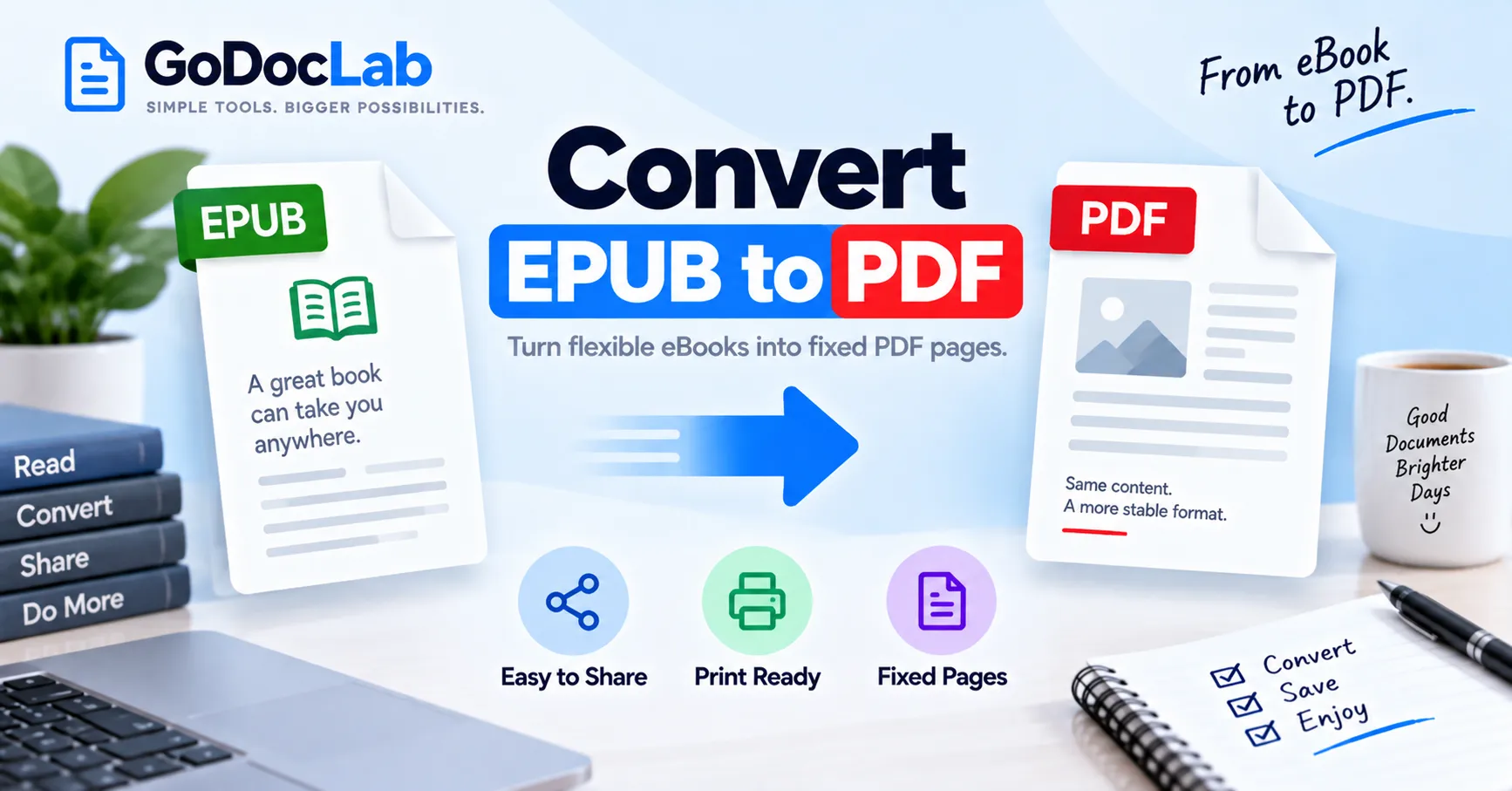
EPUB works well for ebooks because the text can adjust to different screen sizes. PDF works better when you need fixed pages for printing, sharing, or storing a copy that looks the same on different devices. If you need to Convert EPUB to PDF, the main task is turning flexible ebook content into stable pages without losing the reading order.
W3C says EPUB usually uses reflowable content, which means the text can move and resize based on the screen or reading app. EPUB can also use fixed layouts for books where design and text need tighter placement. That difference explains why page breaks, image positions, and spacing may change after conversion.
Quick Answer: How to Convert EPUB to PDF
The basic process is simple: upload the EPUB, run the conversion, download the PDF, and check the result. GoDocLab has a direct EPUB-to-PDF tool that currently accepts EPUB files up to 100 MB and returns a converted PDF. If you want to Convert EPUB to PDF in a browser, this gives you a short path from ebook to fixed document.
Use this process:
Open the .
Select the EPUB file from your device.
Start the conversion.
Download the PDF.
Open the file and check the cover, chapters, images, and page breaks.
Keep the original EPUB in case you need the flexible ebook version later.
A quick review matters because EPUB and PDF handle pages differently. EPUB may adapt to a phone, tablet, or e-reader, while PDF fixes the content onto pages. The conversion can be successful even if the final page count changes.
EPUB vs PDF: What Changes During Conversion?
EPUB is built for flexible digital reading, while PDF is often used for fixed page output. W3C says reflowable EPUB content adjusts to the available screen, which helps the same ebook work across different display sizes. Adobe explains that PDF keeps content in a consistent visual form across devices, which makes it useful for sharing and printing.
This is the main reason Convert EPUB to PDF can change pagination. A chapter that appears as ten screens on an e-reader may become a different number of PDF pages based on page size, margins, fonts, and images. The content can stay correct even when the page numbers change.
Why Convert an EPUB Book to PDF?
People often choose PDF when they need a file that is easier to print, attach to an email, or share with someone who does not use an EPUB reader. PDF also gives fixed page references, which can help with study notes, review copies, and document checks. If you Convert EPUB to PDF for a class, office task, or personal archive, that fixed structure can make the file easier to handle.
EPUB still has clear benefits for normal ebook reading. Its flexible layout can fit phones and e-readers more naturally than a fixed PDF page. The better format depends on what you plan to do after the conversion.
How to Convert EPUB to PDF Online With GoDocLab
GoDocLab’s EPUB-to-PDF page uses an upload, process, and download flow. The live page currently lists EPUB as the supported input and shows a maximum file size of 100 MB. That makes it useful when you want to Convert EPUB to PDF from a browser without adding another desktop program.
Before uploading, open the EPUB in an ebook reader and make sure the source file looks correct. If the original already has missing images, broken chapters, or odd fonts, the PDF conversion may carry those problems into the new file. A file converter changes the format, but it cannot repair every source issue by guesswork.
What Happens to Reflowable Text?
Reflowable EPUB text changes line length and page flow based on the reading window and user settings. W3C says this is the default layout behavior for EPUB, while fixed-layout EPUB exists for books that need more precise placement. When you Convert EPUB to PDF, the converter has to place that flexible text onto fixed pages.
That can change where paragraphs end and where chapters begin on a page. Images may also move compared with the way they looked on one specific e-reader screen. This behavior comes from the format change and does not always mean something went wrong.
Check Images, Covers, and Illustrations
Images can make an EPUB more useful, but they also create more chances for layout changes after conversion. Check the cover, chapter art, diagrams, captions, and any full-page images in the PDF. If you Convert EPUB to PDF for a book where image order matters, compare the output with the source chapter by chapter.
Large images may shrink to fit the PDF page, while smaller images may leave more empty space than they did in the ebook reader. Fixed-layout EPUB files may keep their design more closely, but the final result still depends on how the source file was made. A quick visual check can catch problems before you print or share the file.
What Happens to the Table of Contents?
EPUB publications include navigation data that helps reading software show the book structure. W3C says the EPUB navigation document provides key navigation features such as the table of contents. During conversion, the visible contents page may remain, but interactive links can behave differently in the PDF.
After you Convert EPUB to PDF, click the table of contents entries if the PDF includes links. Check chapter order and page numbering as well, because the fixed PDF now has page references that the original ebook may not have used in the same way. Treat the PDF as a new output that deserves its own check.
Fonts Can Affect the Final PDF
An EPUB may use embedded fonts, device fonts, or CSS rules that an ebook reader handles in its own way. During conversion, font availability and layout rules can change line breaks, spacing, and page count. If the book uses unusual typefaces, check several chapters instead of looking only at the first page.
When you Convert EPUB to PDF, readability matters more than matching one reader screen line for line. The EPUB itself can look different on two devices because flexible text is part of the format. The PDF should aim for a clear, stable result that remains easy to read.
EPUB to PDF vs PDF to EPUB
These two conversions solve opposite jobs. EPUB to PDF turns flexible ebook content into fixed pages, while PDF to EPUB tries to make a fixed document easier to read in ebook software. GoDocLab offers both EPUB to PDF and PDF to EPUB, so the direction should match the file you need at the end.
Use Convert EPUB to PDF when printing, fixed sharing, or stable page references matter more. Use when flexible ebook reading matters more than exact page layout. Choosing the right direction saves you from doing two conversions when one will do.
What If the PDF Is Too Large?
Books with many large images can produce bigger PDF files. If the converted file becomes hard to email, upload, or store, you can reduce its size after conversion. GoDocLab also provides a Compress PDF tool for this next step.
Do not compress every Convert EPUB to PDF result automatically. Check whether the file size actually causes a problem, then compare the smaller copy with the original PDF. Small text, illustrations, and captions should still look clear after compression.
Merge Converted EPUB Books or Sections
You may have several EPUB files that belong to one course, collection, or project. One option is to convert each EPUB separately, then combine the PDFs in the order you want. GoDocLab’s Merge PDF tool can join several PDF files into one document.
This workflow helps when you Convert EPUB to PDF for several related files but want one final package. Check title pages and chapter order before merging so the finished PDF reads naturally. A collection should feel planned, not like the chapters fell out of a folder and landed in random order.
Can EPUB Conversion Affect Accessibility?
EPUB can include structured headings, navigation, alternative text, and other features that help accessible reading software. W3C treats accessibility as part of the EPUB standards family, and flexible presentation can support different reading needs. A PDF conversion may not carry every EPUB accessibility feature into the new file in the same form.
If accessibility matters, test the final PDF instead of assuming every feature came across. A page can look correct on screen while still working poorly with a screen reader or keyboard navigation. Use an accessibility-focused PDF process if the final file needs to meet formal accessibility rules.
Protected EPUB Files May Have Restrictions
Some ebooks include licensing controls that can limit copying or file conversion. Use EPUB files that you own, created, received with conversion rights, or are otherwise allowed to process. If a protected file does not convert, check the publisher or provider terms instead of trying to bypass access controls.
A Convert EPUB to PDF tool handles format conversion, not copyright permission. Keeping that line clear protects both the file owner and the person doing the conversion. It also avoids turning a simple document task into a much bigger problem.
Common Mistakes to Avoid
Most conversion issues are easy to catch if you check the source and the finished file. Do not assume that a successful download means every chapter, image, and link came through perfectly. The checks below cover the problems that show up most often.
Converting a damaged EPUB without testing it first
Deleting the original EPUB too early
Ignoring missing or moved images
Skipping the table of contents check
Expecting the PDF page count to match an e-reader screen count
Compressing before checking image quality
Forgetting to review unusual fonts
Processing protected material without permission
A reliable Convert EPUB to PDF workflow should leave you with a readable book, clear page order, and usable images. Keep the original file beside the PDF until you finish checking the result. If something looks wrong, compare that chapter with the EPUB before sharing or printing.
Final Check Before You Save or Share
A good Convert EPUB to PDF process starts with a healthy EPUB file and ends with a careful PDF review. Check the cover, chapter order, text, images, contents page, page breaks, and file size before sending or printing the document. W3C’s EPUB standard explains why some layout changes are expected because EPUB commonly reflows while the final PDF uses fixed pages.
For the direct GoDocLab workflow, start with , then use only if the result is too large. If several converted books belong together, can combine them, while PDF to EPUB gives you the reverse path. The format should follow the job you need to finish.
FAQs
Frequently asked questions
Yes. GoDocLab provides a browser-based EPUB-to-PDF tool that accepts EPUB files and returns a PDF. The current tool page lists a 100 MB maximum input size and a simple upload, process, and download flow.