Blog
Combine JPG and PDF Files | A Simple Guide for One Clean Document
Sometimes your documents refuse to cooperate. You have a PDF report, three JPG receipts, a scanned signature, and maybe one image called IMG_8472.jpg that nobody remembers taking.
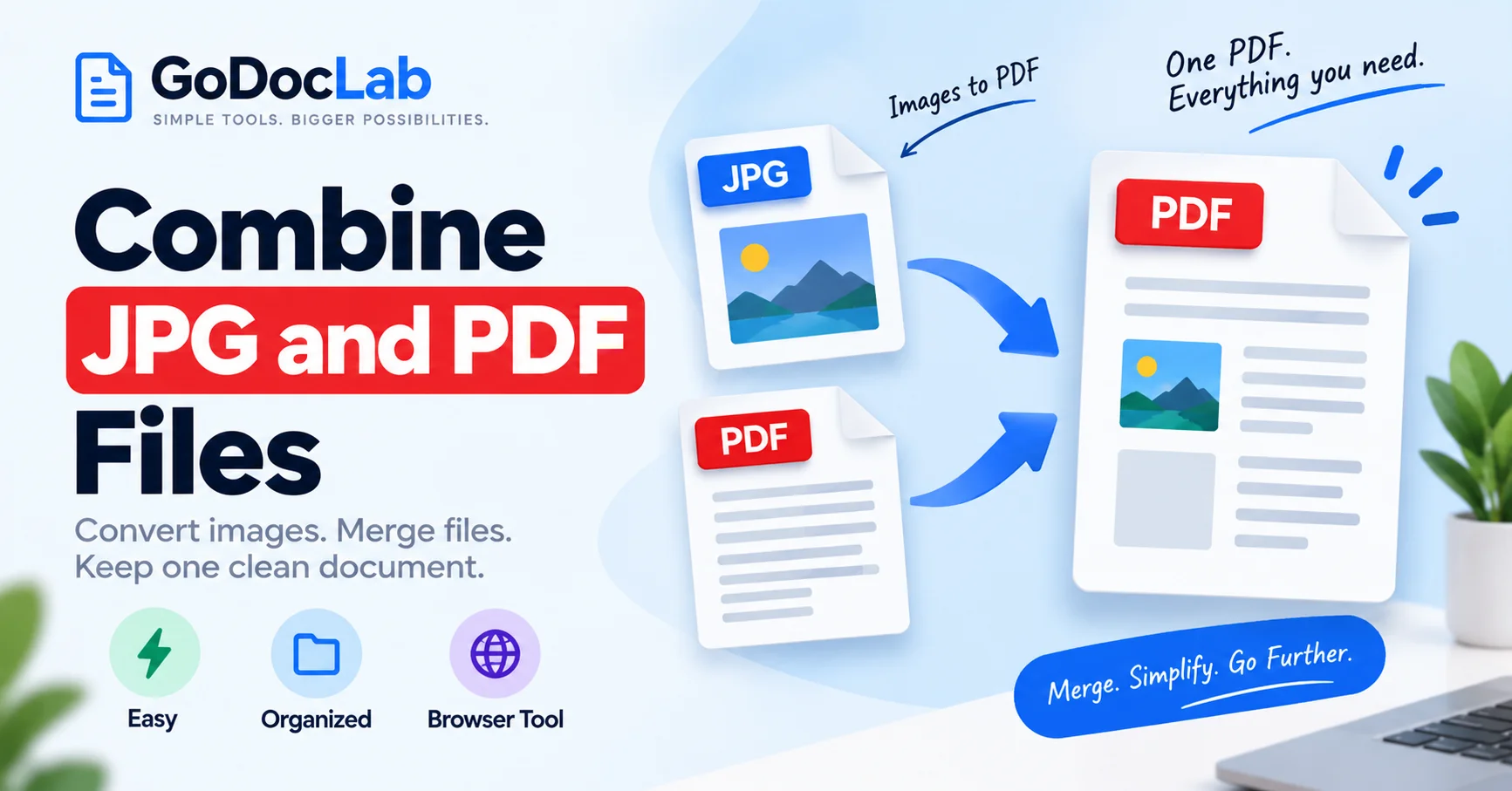
The good news is that you can Combine JPG and PDF files without rebuilding everything from scratch. In most cases, the cleanest method is to turn the JPG images into PDF pages, merge those pages with your existing PDF, arrange the order, and save one finished document.
This guide covers that full process, including file order, image quality, page size, common mistakes, and the tools that fit each step.
Quick Answer: How to Combine JPG and PDF Files
The basic workflow has two parts. Convert the JPG images into PDF format, then merge the converted file with your existing PDFs.
Follow these steps:
Convert JPG images with the GoDocLab Image to PDF tool.
Download the new PDF file.
Open the GoDocLab Merge PDF tool.
Add the converted image PDF and your existing PDF files.
Put the files in the correct order.
Merge them into one document.
Open the finished PDF and check every page.
GoDocLab’s Image to PDF page supports JPG, JPEG, PNG, TIFF, BMP, and GIF files. Its Merge PDF tool accepts PDF files and creates one merged document.
Why Combine JPG and PDF Files?
People often keep related information in different formats. A contract may arrive as a PDF, while receipts, photos, signatures, diagrams, or scanned forms arrive as JPG images.
When you Combine JPG and PDF files, you can keep related material in one document. That makes the file easier to send, archive, print, review, or share with someone who does not want seven attachments.
Common examples include:
Adding JPG receipts to an expense report
Adding scanned signatures to a PDF package
Joining product photos with a PDF proposal
Adding ID scans to an application file
Combining classroom notes with a PDF assignment
Placing image evidence after a written report
One organized file also makes page order easier to control. Your reader can move from page 1 to page 2 without opening a small collection of mystery attachments.
Best Methods for Combining JPG and PDF Files
If your files include both images and PDFs, converting the images first gives every item the same document format. That makes the final merge easier to manage.
Convert JPG Images to PDF First
The most direct GoDocLab workflow starts with JPG to PDF conversion.
Open the Image to PDF tool, upload your image, process it, and download the converted PDF. GoDocLab currently lists JPG, JPEG, PNG, TIFF, BMP, and GIF as supported image formats, with a 100 MB maximum shown on the tool page.
This step matters because GoDocLab’s Merge PDF tool accepts PDF files. Once your image becomes a PDF page, you can place it beside your other PDF documents.
If you need to Combine JPG and PDF files often, naming converted files clearly can save time. receipt-march.pdf tells you far more than converted-7.pdf.
Merge the Converted Images With Your PDFs
After converting your JPG images, open the Merge PDF tool. Add the PDF made from your image along with the other PDF files you want to include.
GoDocLab describes this tool as a way to combine multiple PDF files into one document. Its page shows a simple upload, process, and download flow.
To Combine JPG and PDF files cleanly, check the sequence before you process the final document. Put a cover page first, supporting images where they belong, and appendices at the end.
The software can merge the files. It cannot know that your restaurant receipt belongs after the expense form rather than before the title page.
Can Adobe Acrobat Combine JPG and PDF Files Directly?
Yes. Adobe says Acrobat’s Combine Files tool can work with PDFs, Word files, Excel files, PowerPoint files, JPEG images, other images, emails, and more. Users can add files, preview them, arrange pages, and create one PDF.
That means Acrobat can Combine JPG and PDF files in a single workflow if you already use the desktop app.
Adobe also says you can drag files into the Combine Files window and move items into the order you want before creating the final PDF. This helps when a project contains many different file types.
How to Put JPG Pages in the Right Order
File order deserves more attention than it usually gets. A perfect conversion with the wrong sequence still produces a bad document.
Plan the order before you merge:
Cover or title page
Main PDF content
JPG images related to specific sections
Receipts, scans, or supporting proof
Appendix material
Final notes or closing page
If the final sequence needs work, use GoDocLab’s Reorder Pages tool. The tool changes the page sequence inside an existing PDF.
You can also use Organize PDF when the finished file needs wider page cleanup.
Image Quality Matters Before You Merge
A PDF cannot create missing detail from a poor JPG. If the original image looks blurry, dark, heavily compressed, or cropped badly, the converted page will carry those problems into the final file.
Before you Combine JPG and PDF files, open each image and check:
Text is readable
Important edges are visible
The image faces the right direction
No private content appears by mistake
The scan has enough contrast
The file is the correct image
For receipts and forms, zoom in on small text. A receipt that looks fine as a thumbnail may become a fuzzy gray rectangle once someone tries to read the total.
JPG Page Size and Orientation
JPG images can have many shapes. Some are portrait, some are wide, and phone photos may come from odd angles.
When you convert an image to PDF, check how the image sits on the page. A tall phone photo and a standard document page may look very different inside one merged file.
That does not always create a problem. But if you Combine JPG and PDF files for printing or formal delivery, consistent orientation can make the document easier to read.
GoDocLab also provides image tools for resizing, cropping, and rotating, which can help prepare images before conversion. The main tool directory lists those image options along with its PDF tools.
What If You Only Need Certain PDF Pages?
You may have a 40-page PDF but need only three pages from it. Merging the whole document would add material you do not need.
GoDocLab lists a Selective Page Merge tool that joins chosen pages from different PDF documents. You can also extract the pages you need first, then merge those smaller files with your converted JPG pages.
This approach keeps the final document focused. It also helps avoid the classic problem of sending a client 40 pages when they asked for four.
Merge, Convert, Reorder, or Organize?
These actions sound similar, but they solve different jobs.
A good workflow uses the smallest number of steps needed. Do not split, extract, reorder, compress, and reconvert a file just because all the buttons look interesting.
How to Reduce the Size of a Combined PDF
Photos can make PDFs large because image data often takes more space than plain text pages.
After you Combine JPG and PDF files, check the final file size before emailing or uploading it. If the document feels too large for its purpose, use the GoDocLab Compress PDF tool.
GoDocLab describes its compression tool as a way to reduce PDF file size while keeping document quality in mind.
Keep an original copy before heavy compression if small details matter. Receipts, diagrams, and scanned text need enough image quality to stay readable.
Common Mistakes to Avoid
Most mixed-file problems come from preparation rather than the merge itself.
Avoid these mistakes:
Converting the wrong JPG
Using blurry source images
Ignoring image rotation
Merging files in the wrong sequence
Adding duplicate pages
Forgetting to check the final PDF
Compressing small text too heavily
Uploading private documents without checking your own privacy requirements
To Combine JPG and PDF files well, treat the finished PDF like a new document rather than a pile of files taped together digitally.
Is It Safe to Combine Files Online?
For ordinary documents, browser tools offer a convenient way to process files. For confidential material, check the service’s privacy terms and follow the rules of your workplace, school, client, or organization.
GoDocLab states that it uses HTTPS connections, automatic file deletion, and private processing for uploaded documents.
Do not upload sensitive records to any online service if your rules require local processing. Convenience is useful. A compliance problem is much less fun.
Final Check Before You Save
To Combine JPG and PDF files cleanly, start with good source images, convert them to PDF where needed, merge the files in the right sequence, and inspect the finished document.
For the GoDocLab workflow, use Image to PDF first and Merge PDF second. If the page order needs repair, use Reorder Pages, and use Compress PDF if sharing size becomes an issue.
The goal is simple: one file, sensible page order, readable images, and no surprise page hiding between the receipt and the signature.
FAQs
Frequently asked questions
Yes. You can convert the JPG into a PDF page, then merge it with the existing PDF. Adobe Acrobat can also combine JPEG images and PDFs through its Combine Files feature.